PVC Edge Banding vs ABS: Which One Should You Use?
Published: August 10, 2026 | By GONGDA Team
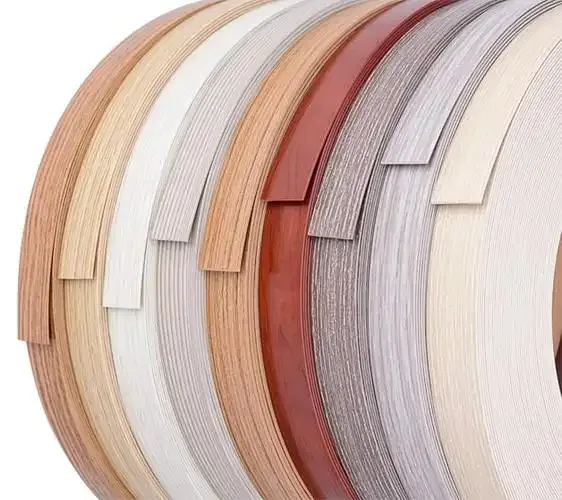
PVC and ABS are the two most widely used thermoplastic edge banding materials in furniture manufacturing. Both do the same job — sealing and protecting panel edges — but they differ in cost, environmental profile, machinability and end-user perception. Here's when to use each, and what the price difference actually is.
Quick Comparison
| Factor | PVC Edge Banding | ABS Edge Banding |
|---|---|---|
| Cost per metre | $0.03–0.12 (depending on thickness) | $0.08–0.22 (30–80% premium) |
| Chlorine content | Contains chlorine (~57% by weight) | Chlorine-free |
| Recyclability | Mechanically recyclable but chlorine content limits some recycling streams | Widely recyclable; preferred in EU circular-economy schemes |
| Heat resistance | Softens at 65–75°C | Softens at 85–95°C |
| Surface hardness | Shore D 65–75 | Shore D 75–82 (harder, more scratch-resistant) |
| UV stability | Good with UV stabilisers | Excellent — inherently UV-stable |
| Edge quality (trimming) | Clean cut, slight whitening at trim line if blades are dull | Exceptionally clean cut; no whitening |
| Laser edge compatibility | Available with functional layer; well-established | Available; slightly higher laser power required |
When PVC Edge Banding Is the Right Choice
PVC edge banding remains the dominant material globally for good reason. It's cost-effective, available in thousands of colours and textures, and works perfectly with standard EVA and PUR hot-melt edge banders. Use PVC when:
- Your target price point is mid-range or budget
- You're selling into markets without strict chlorine-content regulations (most of Asia, Africa, Middle East)
- Colour matching is critical — PVC offers the widest colour range, including metallics and wood grains with synced embossing
- You need 0.4–0.6mm ultra-thin banding, where ABS is rarely competitive on price
GONGDA's PVC edge banding range includes 600+ colours with matching decorative films, available pre-glued or standard.
When ABS Is Worth the Extra Cost
ABS edge banding commands a premium for three reasons: environmental credentials, better edge quality, and higher heat resistance. Upgrade to ABS when:
- EU market compliance: Some European furniture retailers now specify "chlorine-free" edge materials in their procurement guidelines, particularly in Scandinavia and Germany
- High-temperature environments: Kitchen panels near ovens, radiator covers, or furniture destined for hot climates where container shipping temperatures can reach 70°C+
- Premium brand positioning: If your marketing emphasises sustainability (FSC chain of custody, low-VOC, recyclable), ABS fits the narrative better than PVC
- White and light colours: ABS's superior UV stability means white edge banding won't yellow over time — a common complaint with PVC in sunny retail displays
The Price Reality
At current raw-material pricing (August 2026), ABS edge banding costs approximately 40–80% more than PVC for equivalent thickness and colour. For a typical kitchen cabinet order using 20 linear metres of edge banding, the upgrade adds roughly $1.00–2.00 per cabinet — noticeable at scale, but absorbable in the premium segment.
Many of our distributor clients take a hybrid approach: PVC for 80% of their range, ABS for the premium "ECO" or "Green" product line. This lets them offer both price points without overhauling their entire inventory.
Laser Edge Banding: PVC vs ABS vs PP
If you're investing in a laser edge bander, there's a third option to consider: PP (polypropylene) edge banding. PP is chlorine-free like ABS, softer and more flexible, and increasingly popular in European high-volume factories. However, PP has a narrower colour range and can be trickier to trim cleanly. For most factories new to laser edge banding, PVC with a laser functional layer is the easiest starting point — it runs on the same machine settings as ABS and gives excellent results.
Recommendation by Market Segment
| Segment | Recommended | Reason |
|---|---|---|
| Budget / flat-pack | PVC 0.4–0.6mm | Lowest cost, adequate for low-wear use |
| Mid-range residential | PVC 0.8–1.5mm | Best value; good colour range |
| Premium kitchens (EU) | ABS 1.0–2.0mm | Chlorine-free compliance; superior finish |
| Commercial / hospitality | ABS 2.0mm | Durability + sustainability credentials |
| Hot-climate export | ABS or PVC with UV package | Prevents heat-related peeling |
Need a quote for both PVC and ABS edge banding?
We'll price both options for your specific thickness and colour requirements — no commitment needed.
Get Comparative Quote